So you want a tournament app. Here’s what you need to know.
Maybe you want a tournament app for your soccer tournament. Here’s what we learned about event apps by using the 2018 United Soccer Coaches Convention app.
If you attended the convention, did you know the #PHIL18 had an app? Did you use it? If you did, we’d really like to know how. (find Gerard McLean on the app PHL18 and ping me. I’ll even send you a free thing. Don’t try to get the free thing without sending me a message on the app… that would be cheating. Also, my supply is really limited, so only the first five or so.)
We used the app; in fact, we gamified it a bit (just a little; keep reading to see why we didn’t go all out.) But by doing so, we also learned a bit about how a captive audience uses event apps and how you can use what we learned with your own soccer tournament event app.
But first, read our position on making a soccer tournament app. Here and here. (If you remain unpersuaded, here.)
Here are the quick take-aways:
- Photo postings are hot
- Photos with dogs and soccer balls are even hotter!
- Postings with promises of free cookies will lead to meeting interesting people
- Before your event, there will be a ton of engagement
- Nobody likes a team that runs up the score
- Don’t let your host teams hog the spotlight
- Boring stories are… well, boring
- After the event, (and during the event, too!) nobody cares about your app
More detail about each one (and how we know them to be true)
Photo postings are hot
Maybe it was because postings with photos got more points or maybe we are now firmly in the Instagram age where people feel more comfortable, but posting with photos and short captions got the mosts likes and responses. Disclaimer: See boring stories below, though. Not all photos are created equal.
Photos with dogs and soccer balls are even hotter!
Evidence…
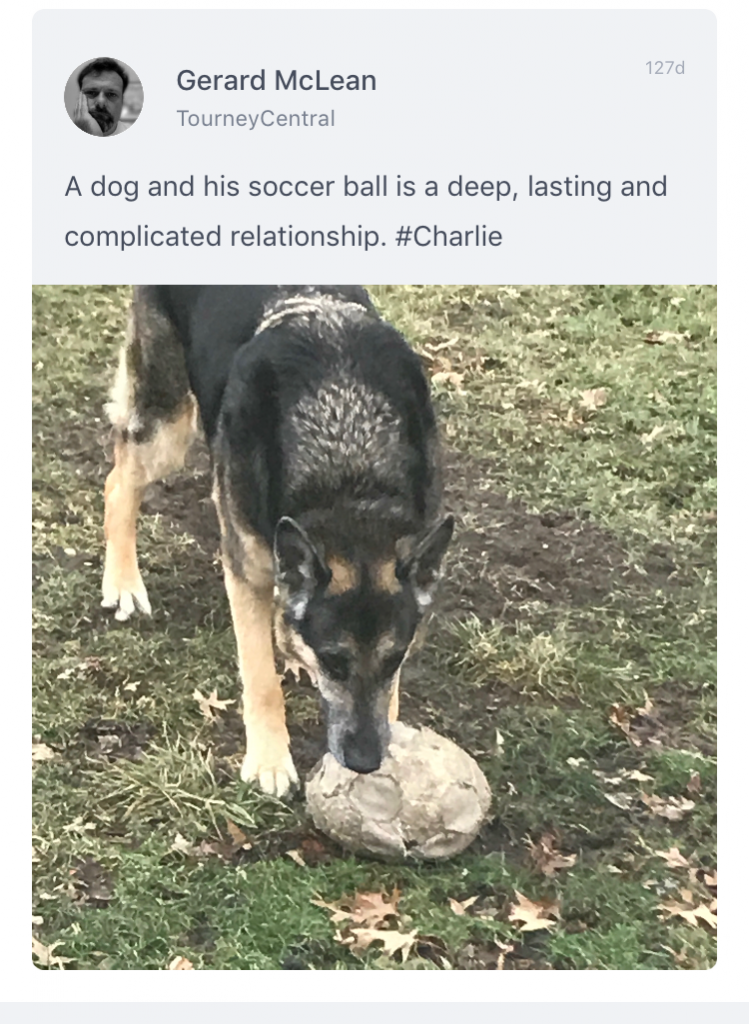
The main takeaway here is that your photos don’t need to be at or of the event you are attending, but they do need to be connected somehow with the experience. Branch out a little, include a personal detail and how what you are experiencing at the event is linked to you. For me, it was my dog, Charlie and his favorite soccer ball…. or what used to be a soccer ball.
Postings with promises of free cookies will lead to meeting interesting people
Seriously, do I even have to say it? People who were at the show and saw our posting in real time showed up; we had cookies and we chatted. No agenda, just sharing free cookies. The cookies did not last long.
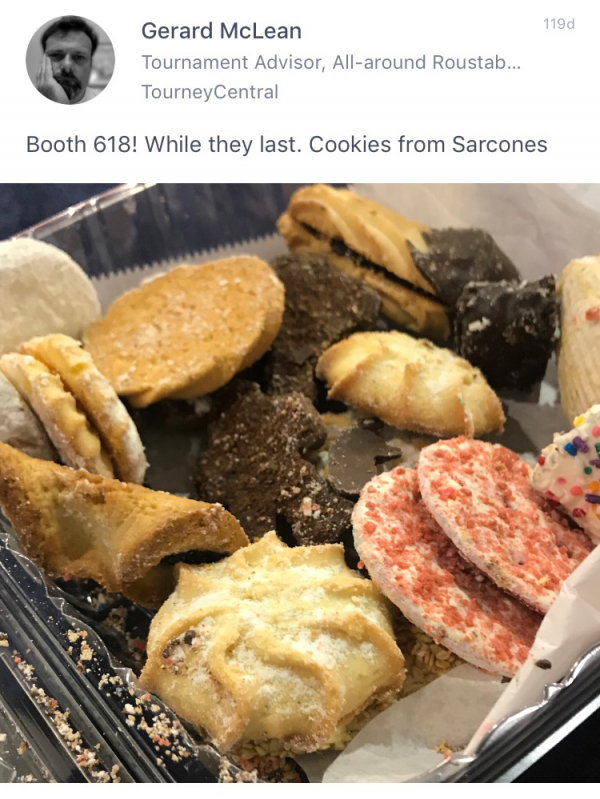
If this photo made you hungry and you need to tear the pantry apart looking for cookies, we can pause… hurry back.
It is not about the cookies as much as it is about doing something a bit different than what everyone else was doing. Everyone else was posting up photos of their Philly cheesesteak or their crew in front of the booth. When I think of Philly, I think Sarcone’s Bakery and their cookies by the pound that I buy way too much of. I also had no agenda; I was not using the cookies to hook you into a conversation at my booth. I just wanted to share the cookies.
Before your event, there will be a ton of engagement
The before crowd is excited to attend the event. When there are not thousands of people all either vying for your attention or aggressively avoiding you, it’s easy to engage on the app at a comfortable pace. People registered, booked a hotel, saw themselves at the conference and “Oooooooooo, they have an app!” They downloaded it, put in a few photos and say something like, “Looking forward to attending/exhibiting/whatever at the conference in Philly #PHL18” They make a few friends on the app who are also excited to be at the conference and stuff their timelines with photos and updates.
Then the conference starts and crickets. The real work of attending workshops, manning the booth, collecting leads, following up, doing lunch, attending award shows and finally crashing exhausted on the hotel bed, get up, do it again tomorrow….. while they may update their own Facebook, Twitter, Instagram and LinkedIn,* posting to the conference app falls off the to-do list.
*These people with other social media accounts are micro-influencers. While they may not share their experiences with you on your app, they are saying something on their own channels to their own audience. If you can get them to use your hashtag in their accounts, call that a win.
Nobody likes a team that runs up the score
Everybody at a soccer tournament has played against that one team at some point. They run up the score, cheering themselves on about what a great job they are doing, oblivious to the humiliation they are causing the other team as well as the branding they get as poor sports. While they see themselves as successful, the other team (and anyone else serious about soccer) looks at the scores and sees a bad winner instead of a strong scoring team.
The same thing applies to the leaderboard or timeline of an event app. There will always be that one person or company that runs up the score by posting non-stop about everything. They believe that life (or sales if they are a vendor) is a numbers games and the more they post, the more they will be seen and remembered.
And they are right, we do remember them, but not in a good way. We see them as annoying jerks who have highjacked our timelines, gamified the leaderboard and forgot that “winning” at a conference wasn’t about the numbers… it was about the people, the engagement. Same, too, with a soccer tournament. Sure, you need to win the games to win a trophy, but winning by crushing everyone just because you can is really not a win; it’s just getting a trophy. It makes you a bad guest.
Don’t let your host teams hog the spotlight
I call this “The Privilege of the Ruling Class” because the insiders use their leverage to get free stuff. We’ve all seen this at events where the players of the host teams march past the concessions line into the HQ tent for snacks and food or the head coach of a host team hangs out in the HQ tent with their players. Maybe they get free rides to their games on a golf cart instead of walking. Maybe they get better seeding than your team.
You know how that feels, especially when you know they are competing for the same trophy as you are. And you paid to be there; they most likely didn’t. It just creates bad feelings all around, like your team has to try twice as hard to just compete.
I was legitimately sharing photos and commenting on postings throughout the day, knowing full well that the #PHL18 convention staff would be logging on in the mornings and evening, commenting and posting, bumping me down on the leaderboard and running up the score. They had the advantage; they were that host team. If I was not engaging as a social experiment, I would have been demoralized. Now, I just have data.
Boring stories are… well, boring
Posting a photo or a company pitch is not a story. Your entire crew standing in front of your booth is not a story. A photo of your Philly cheesesteak when you are in Philadelphia is not a story. A story about a convention being held in a convention center is not a story. These are boring, boring, boring.
Instead, tell us how you arrived at the convention. Give us a story about the quest you embarked upon to procure a special cheesesteak at an out-of-the-way joint you got a hot tip about. Or maybe you ate lunch at a hole-in-the-wall place that had really good Italian food. Who are you? Why are you here? Tell a story in pictures and captions with a beginning, middle and end (or a middle, beginning and end OR even start at the end, go back to the beginning and fill in the middle)
After the event, nobody cares about your app
Maybe “nobody” is a little harsh, but it’s so close to true that we can assume it to be true. So should you. A soccer event has what we have termed, a 90 minute attention span. So do conferences. So do most events.
Our advice:
You should put more energy into your social media platforms, converting micro-influencers to engage with their own content within their own platforms, rather than trying to capture them onto your tournament app platform.
People want your soccer tournament to fit into their lives, not your event into theirs. They already have micro-networks of their own with their friends, family and teammates. They will not share your photo with their networks, nor will they allow you to inject into theirs… unless they give you permission.
They may download your tournament app, they may not, but you will expend a lot of marketing energy trying to get them to. Even if you get a majority of folks to download your tournament app, unless you get 100% of the attendees, you will not reach them on the app without also reaching them on your website (which is also mobile) You are just causing more work for yourself when you need less to be doing during the tournament.
Permission comes in the form of a hashtag, a photo or video share, a mention, a location tag. And it is really hard to get. Like, insanely hard. Be grateful for every single one, even if the numbers are low. For each “share,” remember there are dozens — if not hundreds — of “views” behind it.
Don’t be grabby or needy with attention.
Bottom line, you are now late to the mobile app game. Everyone attending your event already has the top mobile apps downloaded to their phones; Facebook, Twitter, Instagram and LinkedIn…maybe SnapChat, though that has fallen off the radar of late. Your website loads just fine, your site is mobile and they can get scores and standings on their phones already without an app. The photo they care about are photos they take themselves or get on their friends’ Facebook and Instagram timelines or through iMessage (really, the soccer market is 87% iPhone.)
Learn to work with where your audience is instead of trying to drag them off to another platform you wish they had. While it may be your most enthusiast users will download your app, they will be a small minority of your total audience. Speak to them but don’t lose sight of the larger picture.
Learn from our attendance at the United Soccer Coaches Conference. Or, better yet, come out to the one in 2019 in Chicago!
See you there. We’ll probably search for you on their app.